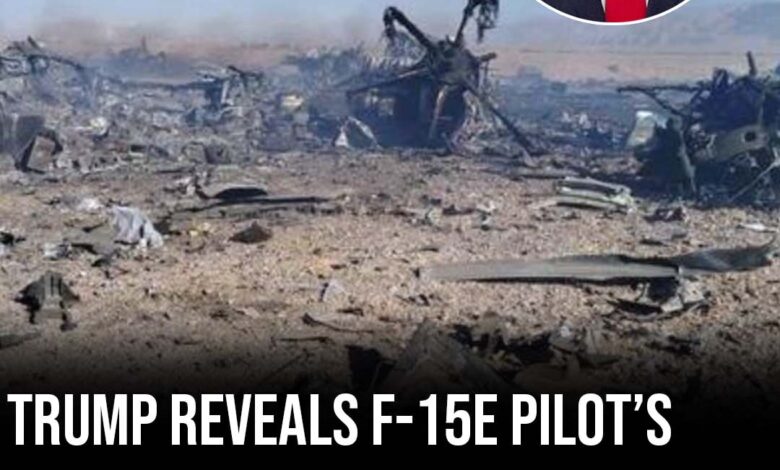
Doubt and Data: Inside the High-Stakes Rescue of a Downed U.S. Pilot
A fragile radio transmission from a downed American pilot deep inside contested airspace near Iran triggered a tense chain of events inside the White House Situation Room. The signal, weak and irregular, lacked the clarity of standard military communication, raising an immediate and dangerous question among U.S. defense officials: was this a genuine distress call, or a sophisticated attempt at deception in an era of advanced electronic warfare?
As analysts worked to authenticate the message, intelligence teams deployed advanced filtering and signal verification tools to dissect the transmission. While the voice and identifiers appeared consistent with the missing pilot, experts warned that modern spoofing technologies could convincingly replicate such data. The uncertainty created a critical dilemma—authorize a rescue mission and risk walking into a trap, or delay and potentially lose a service member. Meanwhile, on the ground, the pilot—ejected from an F-15E Strike Eagle—was injured, disoriented, and transmitting increasingly fragmented messages from isolated terrain.
The turning point came through layered analysis rather than definitive proof. Subtle environmental distortions in the signal suggested it originated from a real field radio, not a fabricated source. Acting on that probability, U.S. forces launched a nighttime extraction mission. Flying low to avoid detection, rescue teams located the pilot alive and secured him in a swift operation. The incident has since emerged as a case study in modern military decision-making—highlighting the growing challenge of distinguishing real signals from digital deception, and the reality that even the most advanced systems cannot eliminate uncertainty in high-risk operations.